
“What sort of a system is that, which its advocates admit may be utterly deranged by a bad crop in England or by the prohibition of the Opium trade in China? The Experiment has now, at least, been fairly tried.”
— Richmond Enquirer, November 12, 1839
A month after Philadelphia’s banks suspended the redemption of their notes in gold and silver, the Richmond Enquirer published excerpts from a letter asking why the suspension had come when it did. The writer suspected that the banks had waited until after the Philadelphia elections, but the letter also pointed to a problem that went well beyond local politics. The Pennsylvania Bank of the United States had short-term notes coming due, and perhaps this was a sign that the bank was failing to meet its obligations in Europe. The bank had defended its actions as a reaction to a bad crop in England, but the letter turned this argument against the system itself. If a bad crop in England could help bring an American bank to the point of suspension, why was the federal government still entrusting public money to institutions exposed to that danger? Richmond Enquirer, “Views on the Bank Suspension”
A Bad Harvest and a Tightening Credit Market
As Britain entered 1839, it was already dealing with the effects of a poor harvest the year before. In May, Thomas Attwood told the House of Commons that large grain imports had contributed to a drain of gold from the Bank of England. The Bank raised its discount rate from 4 percent to 5 percent in May, then to 5½ percent in June, and finally to 6 percent in August. As wet weather made the prospects for the 1839 harvest uncertain, another short crop threatened to force Britain to buy more grain abroad and put even greater pressure on British credit. Those same reports gave American flour dealers reason for optimism. A New York dispatch dated July 30 reported that dealers were beginning to hope for a good market abroad and uncertainty about the English crop was helping prop up flour prices for American farmers who were gathering a rich harvest of their own. An English grain shortage could guarantee American farmers a profitable market for their surplus even while threatening the credit on which American commerce depended. Cheraw Gazette and Pee Dee Farmer, August 9, 1839, p. 3
Van Buren’s Appeal to Congress
When Martin Van Buren addressed Congress on December 2, Congress was already familiar with the tightening of credit in England from commercial reporting from Congress’s own efforts to relieve financial distress. After the Panic of 1837, Congress had given importers more time to pay their customs duties and banks more time to return public deposits after they suspended specie payments. The Treasury issued notes to cover the shortfall. In essence, the government had to borrow to meet its expenses while it waited for the banks to return money it already owned. The English harvest gave Van Buren a way to show how far that dependence reached into American trade. Americans in the past saw a foreign crop shortage as an opportunity to sell their own produce, but now, according to Van Buren, they awaited news of the English harvest with “feverish anxiety,”. They were fearful that its failure would make credit harder to obtain. “Does not this speak volumes to the patriot?” Van Buren asked. His question was about what Americans had come to fear most. Could a system be “beneficent, wise, or just” if it made them more anxious about access to foreign credit than about the prosperity of their own nation and the fortune of their own labor?
This brought Van Buren back to the question of who should keep the government’s money. “The only ground on which that custody can be desired by the banks,” he said, “is the profitable use which they may make of the money.” Banks could use federal deposits to expand their lending and earn a return. Van Buren compared that privilege to an officer who would put public money to private use and thus violate his trust. Van Buren suggested that allowing banks to use public money for private profit might, over time, do even more harm. The privilege also gave banks and their stockholders a stake in how much the government collected and how much it kept. Van Buren argued that it made it their interest to seek “the increase of taxation and the accumulation of a surplus revenue.” The more public money that accumulated in their vaults, the more they could put to profitable use. He warned that banks had reason to press officials for favorable legislation and that public deposits gave them the means to issue more paper. Van Buren reasoned that his encouraged speculation and borrowing abroad, leaving banks vulnerable to another suspension at home.
The Richmond Enquirer correspondent had asked what kind of banking system could be thrown into disorder by a bad crop in England. Van Buren put the question to Congress in terms of its own responsibilities. If pressure in London forced American banks to suspend payments again, would the government once more have to borrow while it waited for its own revenue? Van Buren used this opportunity to once again propose an Independent Treasury. Public officers would collect, hold, and disburse federal funds. By receiving payment in gold or silver, the Treasury would have money it could spend without first asking a bank to honor its promise. American merchants and banks would still have reason to follow the English harvest and the London money market. Congress could give the Treasury a way to pay the government’s bills even when the banks could no longer pay theirs.
Here is the full excerpt from Martin Van Buren’s State of the Union Address.
“Nor is it only in reference to the effect of this state of things on the independence of our Government or of our banks that the subject presents itself for consideration; it is to be viewed also in its relations to the general trade of our country. The time is not long passed when a deficiency of foreign crops was thought to afford a profitable market for the surplus of our industry, but now we await with feverish anxiety the news of the English harvest, not so much from motives of commendable sympathy, but fearful lest its anticipated failure should narrow the field of credit there. Does not this speak volumes to the patriot? Can a system be beneficent, wise, or just which creates greater anxiety for interests dependent on foreign credit than for the general prosperity of our own country and the profitable exportation of the surplus produce of our labor?
The circumstances to which I have thus adverted appear to me to afford weighty reasons, developed by late events, to be added to those which I have on former occasions offered when submitting to your better knowledge and discernment the propriety of separating the custody of the public money from banking institutions. Nor has anything occurred to lessen, in my opinion, the force of what has been heretofore urged. The only ground on which that custody can be desired by the banks is the profitable use which they may make of the money. Such use would be regarded in individuals as a breach of trust or a crime of great magnitude, and yet it may be reasonably doubted whether, first and last, it is not attended with more mischievous consequences when permitted to the former than to the latter. The practice of permitting the public money to be used by its keepers, as here, is believed to be peculiar to this country and to exist scarcely anywhere else. To procure it here improper influences are appealed to, unwise connections are established between the Government and vast numbers of powerful State institutions, other motives than the public good are brought to bear both on the executive and legislative departments, and selfish combinations leading to special legislation are formed. It is made the interest of banking institutions and their stockholders throughout the Union to use their exertions for the increase of taxation and the accumulation of a surplus revenue, and while an excuse is afforded the means are furnished for those excessive issues which lead to extravagant trading and speculation and are the forerunners of a vast debt abroad and a suspension of the banks at home.
Impressed, therefore, as I am with the propriety of the funds of the Government being withdrawn from the private use of either banks or individuals, and the public money kept by duly appointed public agents, and believing as I do that such also is the judgment which discussion, reflection, and experience have produced on the public mind, I leave the subject with you. It is, at all events, essential to the interests of the community and the business of the Government that a decision should be made.
Most of the arguments that dissuade us from employing banks in the custody and disbursement of the public money apply with equal force to the receipt of their notes for public dues. The difference is only in form. In one instance the Government is a creditor for its deposits, and in the other for the notes it holds. They afford the same opportunity for using the public moneys, and equally lead to all the evils attendant upon it, since a bank can as safely extend its discounts on a deposit of its notes in the hands of a public officer as on one made in its own vaults. On the other hand, it would give to the Government no greater security, for in case of failure the claim of the note holder would be no better than that of a depositor.”
References
Van Buren, Martin. “Third Annual Message.” 2 Dec. 1839. The American Presidency Project, University of California, Santa Barbara, https://www.presidency.ucsb.edu/documents/third-annual-message-4. Accessed 12 Oct. 2026.
“Exportation of Gold.” Hansard, House of Commons, 30 May 1839, vol. 47, cols. 1139–56. UK Parliament.
“The Money Market—Loan (Discount on Instalments).” Hansard, House of Commons, 10 May 1847, vol. 92, cols. 599–669. UK Parliament.
New York dispatch dated 30 July 1839. Cheraw Gazette and Pee Dee Farmer, 9 Aug. 1839, p. 3. Historical Newspapers of South Carolina.
“Views on the Bank Suspension.” Richmond Enquirer, 12 Nov. 1839. Historical Bank Runs.
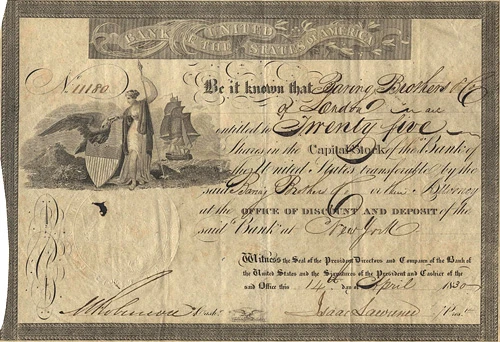
Second Bank of the United States. Stock certificate for 25 shares issued to Baring Brothers & Co. 14 Apr. 1830. Museum of American Finance, www.moaf.org/images/exhibit/197_11_17.webp.
No comments:
Post a Comment