
To fund the civil war, Abraham passed a number of war measures including Legal Tender Acts, the printing of legal tender which became known as "greenbacks". These notes were not backed by Gold. Abraham Lincoln was also the first president to institute a federal income tax. And in Lincoln's 1864 annual address to congress, he outlined his third financial success, that of establishing the national banking system.
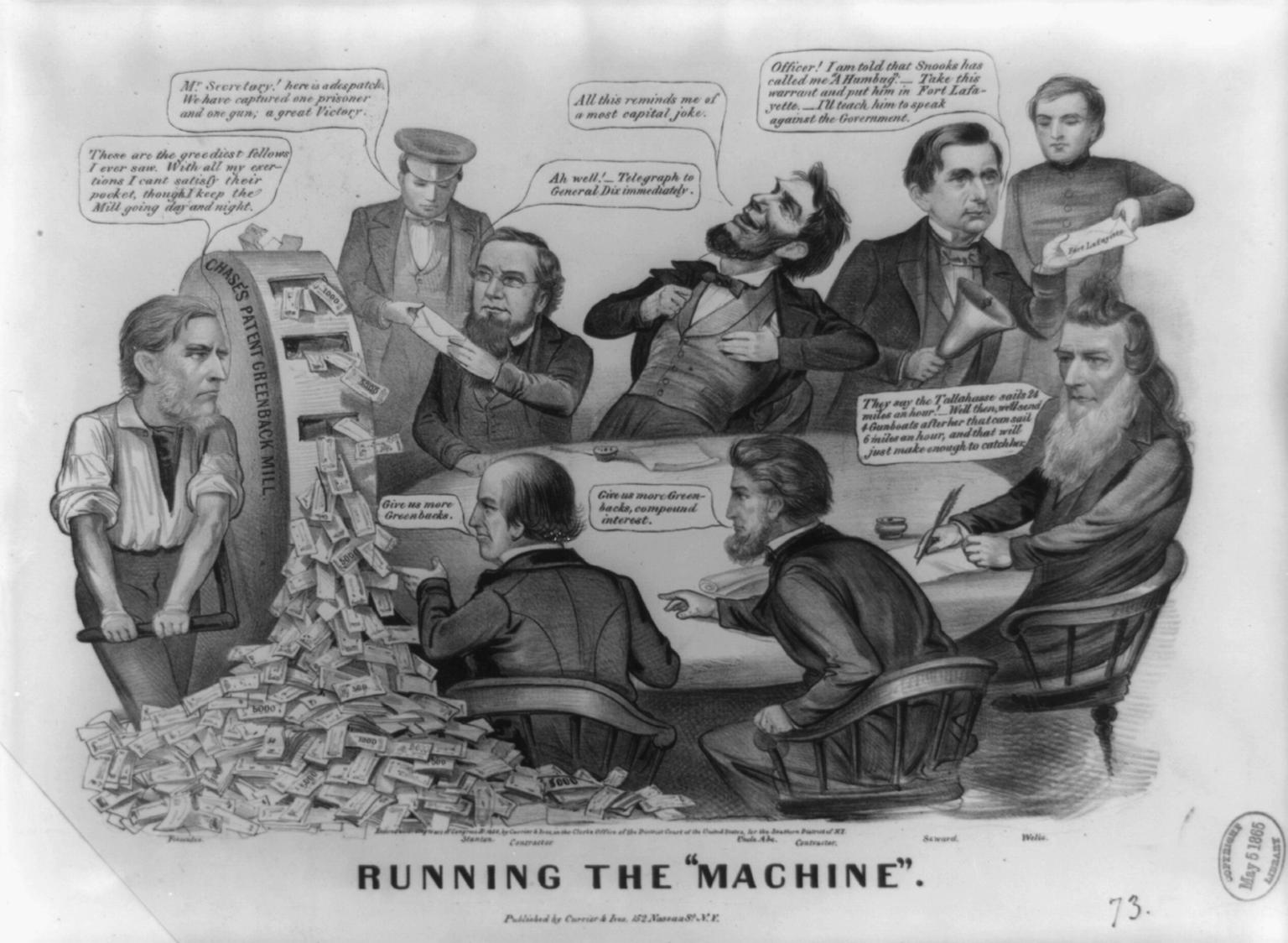
"The national banking system is proving to be acceptable to capitalists and to the people. On the 25th day of November 584 national banks had been organized, a considerable number of which were conversions from State banks. Changes from State systems to the national system are rapidly taking place, and it is hoped that very soon there will be in the United States no banks of issue not authorized by Congress and no bank-note circulation not secured by the Government. That the Government and the people will derive great benefit from this change in the banking systems of the country can hardly be questioned. The national system will create a reliable and permanent influence in support of the national credit and protect the people against losses in the use of paper money. Whether or not any further legislation is advisable for the suppression of State-bank issues it will be for Congress to determine. It seems quite clear that the Treasury can not"The picture above is a political cartoon from the 1864 election depicting Secretary Fessenden of the Lincoln administration running "Chase's Mill" at left to flood the country with Greenbacks. We often remember Lincoln as the savior of the union, and might imagine that everyone would be singing his praises, yet in 1864 this is far from the truth. In the book April 1865 by Jay Wink, the author writes “He was often criticized by the press, scorned by Washington society, held up as the object of lofty condescension by Eastern sophisticates. … To his harshest critics, he appeared remarkably clumsy and inept.” Even today, some question his war measures, and refer to his presidency as a dictatorship.
http://
http://en.wikipedia.org/
https://upload.wikimedia.org/wikipedia/commons/6/64/RunningtheMachine-LincAdmin.jpg
History, has indeed been more than kind towards Lincoln. If not conspiratorial.
ReplyDeleteThe enduring myth of freeing the slaves, is an absolute construct. In fact history rarely if ever mentions Lincoln’s relationship with Horace Greeley, except in passing. That is to say, never in context. Given that Karl Marx was a contributing author to the New York Tribune, for a decade. Nor is any attention noted of the revolutionaries Lincoln appointed as generals, some of whom were personal friends with Marx. Or, the fact that the GOP, was founded by, what would be considered as RADICALS, by today’s standards. Well, not by all, today, SADLY.
Looking over Lincoln’s employers (Railroad BARRENS) it becomes clear who was making the decisions for him.
To say Lincoln was any kind of humanitarian falls flat, when you consider his treatment of the Indians. Standing in the way of the westward expansion. No, Lincoln isn’t worthy of his deification, that continues unabated
Yes, but lets not lie about the greenbacks which were publicly issued money as money, not credit issued as money, not as a commodity issued as money, both of which are controlled by private interests for personal gain. The complaints came not from the public but from the Washingtion elites and international bankers who hated Lincoln for the debt-free greenbacks which when issued, debt began to disappear from the economy, interest rates went down and farmers and small businesses felt freedom. The elites still control the money and information today, clearly. Lincoln had faults, greenbacks were not one of them. monetaryalliance.org
ReplyDeleteThe greenback in my opinion was a double-edged sword. It wasn't a debt instrument; however, it was not backed by gold or silver. Given the de facto government at the time, the Congress didn't have a quorum needed to pass Constitutional legislation due to the absence of the representatives from 11 states. That being said, he did keep the European bankers at bay for a while (at least until 1871). Perhaps if Sherman and Grant hadn't destroyed half the country in their campaigns, massive loans from the Crown and Vatican wouldn't have been necessary and we wouldn't be a corporation to this day.
ReplyDeleteSeems to me that the Greenback had printed on it that it “would” be redeemable for $1.00 ! Back in those days, ONE DOLLAR AMOUNTED TO A SPECIFIC WEIGHT OF GOLD, or silver.
Delete